Granulation Equipment Complete Guide to Processing Technology and Industrial Applications
Imagine holding a tablet of medicine, a handful of fertilizer, or a packet of instant beverage mix. Although these products look very different, many of them have something in common—they began as fine powders before being transformed into uniform granules.
That transformation is made possible with Granulation Equipment, an important part of modern manufacturing across several industries.
Granulation is much more than simply making particles larger. It helps improve how materials flow, mix, store, and move through production lines. Uniform granules also make manufacturing more consistent and reduce the amount of airborne dust created during processing.
From pharmaceutical laboratories to food factories and agricultural plants, Granulation Equipment helps manufacturers create products with reliable quality and consistent physical properties. Understanding how these machines work offers a better appreciation of the engineering behind many everyday products.
What Is Granulation Equipment?
Granulation Equipment refers to machines that convert fine powder into larger, stronger, and more uniform particles called granules. These granules are easier to process during later manufacturing stages such as blending, compression, packaging, and transportation.
Depending on the material and the production method, granulation can be achieved through moisture, pressure, or mechanical action. Each process aims to improve the handling characteristics of powdered materials while maintaining product consistency.
Industries that commonly use Granulation Equipment include:
- Pharmaceutical manufacturing
- Food processing
- Agriculture
- Chemical production
- Mineral processing
- Biotechnology
- Animal nutrition
Although each industry has different production goals, the purpose of granulation remains largely the same—creating stable, uniform particles that perform consistently.
Why Granulation Is Important
Fine powders can present several practical challenges during manufacturing. Granulation helps solve many of these issues.
Improved Material Flow
Powders sometimes stick together or flow unevenly through production equipment. Granules usually move more smoothly, making manufacturing easier to control.
Lower Dust Generation
Fine particles can become airborne during handling. Granulation reduces dust by combining smaller particles into larger, more stable granules.
Consistent Mixing
Uniform particle sizes improve blending and help create more consistent finished products.
Easier Storage and Handling
Granules are often easier to transport, package, and store than loose powders, especially in large production environments.
How Granulation Equipment Works
Although equipment designs vary, most granulation processes follow similar steps.
Material Preparation
The process begins with carefully measuring and mixing raw materials. Uniform blending at this stage supports consistent granule formation later.
Granule Formation
The equipment applies pressure, moisture, or mechanical energy to bind powder particles together.
Different machines use different techniques depending on the desired granule characteristics.
Drying
Some granulation methods involve moisture. In these cases, the newly formed granules pass through drying equipment to remove excess water.
Proper drying helps improve granule stability.
Screening
Granules are screened to separate particles by size.
Oversized particles may be processed again, while undersized particles can return to the granulation stage.
Types of Granulation Equipment
Different production processes require different types of equipment.
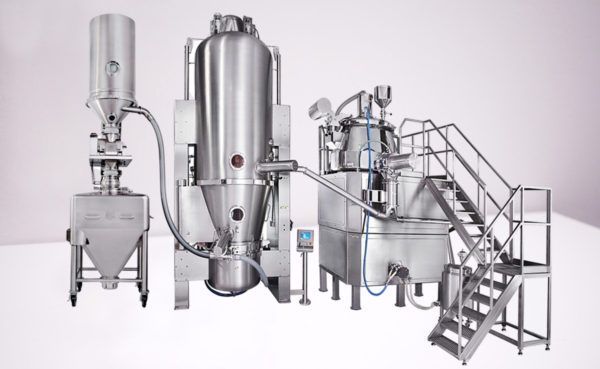
High-Shear Granulators
These machines use rapidly rotating blades to mix powders and binding liquids.
The high-speed movement creates dense, uniform granules within a relatively short time.
Fluid Bed Granulators
Fluid bed systems suspend particles in moving air while introducing a binding solution.
This process combines mixing, granulation, and drying in a single system.
Roller Compactors
Roller compactors create granules using mechanical compression instead of liquid binders.
This method is often referred to as dry granulation.
Oscillating Granulators
Oscillating machines push materials through specially designed screens to create particles of relatively consistent size.
Extrusion Granulators
These systems force material through shaped openings before cutting it into uniform granules.
Extrusion is commonly used when specific particle shapes are required.
Wet Granulation and Dry Granulation
Two primary manufacturing methods dominate granulation processes.
Wet Granulation
Wet granulation introduces a liquid binder that helps powder particles adhere together.
Advantages include:
- Strong particle formation
- Good size consistency
- Effective mixing
After granulation, the material usually undergoes drying before further processing.
Dry Granulation
Dry granulation uses pressure instead of liquid to form granules.
This method is suitable for materials that are sensitive to moisture or elevated temperatures.
The selection between wet and dry granulation depends on the physical characteristics of the material being processed.
Applications Across Industries
Granulation technology supports manufacturing in numerous sectors.
Pharmaceutical Industry
Medicines often require uniform granules before tablet compression.
Consistent particle size contributes to reliable manufacturing.
Food Processing
Food manufacturers use granulation when producing products such as:
- Nutritional supplements
- Beverage powders
- Seasoning blends
- Baking ingredients
Granules help improve product consistency during packaging and preparation.
Agriculture
Granulated fertilizers spread more evenly across agricultural land than loose powders.
Chemical Industry
Many chemical products benefit from improved flow characteristics created through granulation.
Animal Nutrition
Granulation helps create feed products with consistent particle distribution.
Main Components of Granulation Equipment
Most granulation systems contain several important components.
Mixing Chamber
This is where raw materials combine before granules begin forming.
Impeller or Mixing Blades
Mixing devices distribute ingredients evenly throughout the process.
Binder Delivery System
Some equipment introduces binding liquid using controlled spray systems.
Drying Unit
Dryers remove moisture after wet granulation.
Screening Equipment
Screens classify finished granules according to particle size.
Benefits of Modern Granulation Equipment
Manufacturers continue using granulation because it provides several practical advantages.
Consistent Product Quality
Uniform granules contribute to more predictable manufacturing results.
Improved Process Efficiency
Better material flow helps reduce interruptions during production.
Cleaner Production Areas
Reduced dust helps improve cleanliness throughout manufacturing facilities.
Flexible Production
Many systems can process different materials with appropriate adjustments.
Technology Advancements
Modern Granulation Equipment continues evolving through digital innovation.
Automated Controls
Automation helps maintain consistent processing conditions.
Real-Time Monitoring
Sensors continuously measure:
- Temperature
- Moisture content
- Mixing speed
- Pressure
- Process duration
This information helps maintain stable production conditions.
Smart Manufacturing
Digital systems collect production data that supports process optimization and equipment monitoring.
Energy-Conscious Design
Newer equipment often incorporates designs that improve operational efficiency while reducing energy consumption.
Granulation Equipment Overview
| Equipment Type | Common Purpose |
|---|---|
| High-Shear Granulator | Dense granule production |
| Fluid Bed Granulator | Mixing, granulation, and drying |
| Roller Compactor | Dry granulation |
| Oscillating Granulator | Particle sizing |
| Extrusion Granulator | Uniform granule formation |
Looking Ahead
Granulation technology continues advancing as manufacturers adopt automation, artificial intelligence, and digital monitoring systems.
Future developments are expected to include:
- Smarter process control
- Improved production consistency
- Enhanced equipment monitoring
- Predictive maintenance systems
- Greater integration with automated manufacturing lines
These innovations support efficient production while maintaining consistent product quality.
Conclusion
Granulation Equipment plays an essential role in transforming fine powders into uniform granules used across pharmaceutical, food, agricultural, and industrial manufacturing. By improving material flow, reducing dust, and creating consistent particle sizes, these systems support efficient production and reliable processing. As digital technologies continue to develop, modern granulation equipment is becoming more intelligent, precise, and adaptable to the changing needs of manufacturing industries